
Surface Chemistry and Particle Transport
Surface Chemistry and Particle Transport: Morphology of particle deposits, particle transport, aggregation, filtration, particle characterization, and surface chemistry.
Environmental Nanotechnology
Environmental Nanotechnology: fabrication, transport and fate in the environment, risk assessment, photocatalytic properties, toxicity, new environmental technologies.
Overview
Nanotechnologies, will have broad social, economic, and environmental implications; in some cases entirely unanticipated. Our work addresses both applications of nanomaterials that will enable sustainability and the implications of these materials for public health and the environment.
We are developing new processes based on emerging nanomaterials that include membranes,[i],[ii] [iii][iv]catalysts[v], and adsorbants is very much in this spirit.
Along with research on the use and fabrication of naomaterials, is the need to consider impacts of nanomaterials on environment and human health[vi].[vii] Nanomaterials will have an increasing presence in consumer products and commercial applications that already include nano-engineered titania particles for sunscreens and paints, carbon nanotube composites in tires, and silica nanoparticles as solid lubricants, and protein-based nanomaterials in soaps, shampoos, and detergents. Industrial applications currently being marketed include the use of alumina nanoparticles in the manufacture of propellants, pyrotechnics, and ceramics membranes, nanoparticles in semiconductor manufacture, and numerous biomedical applications. If the current trend in commercial ventures continues, we will soon find ourselves with a relatively large nanomaterials industry. Forethought as to how environmental risks associated with the production, use and disposal of these materials can be best managed is needed sooner rather than later. Indeed, as environmental engineers and scientists, we have a special obligation to not only look for matches between nanotechnologies and environmental needs, but also to anticipate unintended, perhaps negative consequences associated with the growth of an emerging nanotechnology industry. A critical element of this charge is to perform forward-looking research that explores the possible environmental implications of the products of nanochemistry and their fabrication.
Research in the Wiesner Group area includes an examination of the transport and fate of nanomaterials in aqueous environments[viii][ix], collaborating with toxicologists to assess environmental and health hazards, examining the elements of nanomaterial surface chemistry and reactivity that affect toxicity and mobility, and performing life cycle assessments of environmental impact and risk associated with nanomaterials production, use, and disposal.
References Cited
[i] Bailey, D.A., C.D. Jones, A.R. Barron, and M.R. Wiesner, “Characterization of alumoxane-derived ceramic membranes,” Journal of Membrane Science. 176:1-9, 2000.
[ii] Jones, C.D., Fidalgo, M.M., Wiesner, M.R. and Barron, A.R., “Alumina ultrafiltration membranes derived from carboxylate-alumoxane nanoparticles,” Journal of Membrane Science, 193: 175-184, 2001.
[iii] Cortalezzi, M.M., J. Rose, A.R. Barron, M.R. Wiesner, “ Ceramic membranes derived from ferroxane nanoparticles: a new route for the fabrication of iron oxide ultrafiltration membranes,” Journal of Membrane Science in press, 2003.
[iv] DeFriend, K.A., M.R. Wiesner, and A.R. Barron, “ Alumina and Aluminate ultrafiltration membranes derived from alumina nanoparticles,”Journal of Membrane Science, in press.
[v] Rose, J., Fidalgo, M.M., Moustier, S., Magnetto, C., Jones, C.R. , Barron, A.R., Wiesner, M.R., and Bottero, J.Y., “ Synthesis and Characterization of Carboxylate-FeOOH Particles (Ferroxanes) and Ferroxane-derived Ceramics, “ Chemistry of Materials, 14:621-628, 2002.
[vi] “Environmental Implications of Nanotechnologies” M.R. Wiesner, Environmental Engineer AAEE, 2003.
[vii] Wiesner, M.R. and Colvin, V. “ Environmental Implications of Emerging Nanotechnologies: Avoiding the Wow to Yuck Trajectory, “ The Environmental Future, Woodrow Wilson Center Press, 2003.
[viii] Lecoanet, H., J.Y. Bottero, and M.R. Wiesner, “Mobility of fullerene-based nanomaterials in porous media,” Nature, submitted.
[ix] Wiesner, M.R., Lecoanet, H., and M. Cortalezzi, “Nanomaterials, sustainability and risk assessment,” Proceedings International Water Association Conference on Nano and Micro Particles in Water and Wastewater Treatment, Zurich, Switzerland, 2003.
Proton transport membranes for Fuel Cells
Image
Image
Environmentally Benign Synthesis of Alumina Based Ceramics
Researchers: Maria Fidalgo-Cortalezzi, Diane Bailey, Jerome Rose
Image
We have developed in collaboration with researchers in Andrew Barron's group in the Chemistry
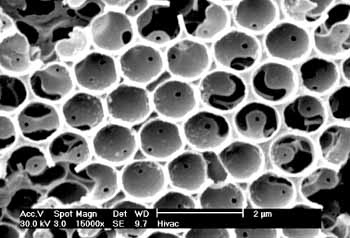
Department at Rice University an environmentally benign chemical process for producing alumina based ceramics. The focus of work to being conducted in our group is on developing and characterizing an entirely new class of ceramic membranes based on alumoxane chemistry for applications in environmental separations. Ceramic membranes are promising in applications such as treating hazardous and industrial wastes, or recovering materials during chemical production that may, due the presence of solvents or high temperatures, destroy conventional polymeric membranes. The alumoxane membranes being developed at Rice avoid the use volatile organic chemicals in membrane fabrication, reduce costs, and improve energy efficiency.
The scope of the project includes fundamental research into aqueous processing of alumina-precursors and their processing into a membrane film with desirable characteristics of thickness, pore size distribution, permeability, and surface chemistry. We hope to exploit the properties of various alumoxanes to produce membranes with a range of effective pore sizes or cutoffs and cast these materials on suitable porous supports.
We have successfully shown that the alumoxane pathway can be manipulated to produce ceramics with narrow pore size distributions. The mean of these distributions can be currently controlled within the range of approximately 10 to 50 nm. Of particular interest is the fact that mean pore sizes readily achievable by this approach are considerably smaller than those obtainable for alumina-based ceramics produced from the sol-gel method. It appears to be possible to produce membranes in the nanofiltration range without resorting to the use of zirconia- or titania-based ceramics as required to produce pores of similary small size when using the sol-gel method.
Application of the alumoxane-based approach to creating ceramic membranes will ieliminate the use of toxic solvents and reduce energy consumption. Byproducts formed from the combustion of plasticizers and binders will be minimized, and the use of acids eliminated. Thus, the process will reduce the potential for environmental release through the use of more environmentally benign feedstocks and an alternative synthetic procedure which will improve energy efficiency.
Also, due to the very versatile nature of the process, the proposed alumoxane process holds the potential for fabricating new ceramic nanofiltration and ultrafiltration membranes with enhanced specificity. Due to their stability under exposure to high temperatures, organic solvents, and oxidants, ceramic membranes are particularly well suited to separations required in less environmentally benign industrial processes in which options for pollution prevention must focus on materials recovery and reuse in the absence of suitable alternative processes.
Treatment of Produced Waters by Ultrafiltration
S. M. Santos and M. R. Wiesner
Abstract
Produced water from gas and oil operations is purportedly the largest single source of waste generated in the United States with an annual production rate of over 3 billion tons. Results are presented from bench scale pilot tests of membrane ultrafiltration of produced waters obtained from three operating oil and gas wells. Ultrafiltration reduced concentrations of grease and oil in the three produced waters evaluated in this work to well below current and anticipated regulatory limits. Permeation flux varied greatly from one produced water to another. Because membrane cost is greatly influenced by permeate flux, generalizations regarding the economic or technical feasibility of UF treatment of produced water based on the limited number of laboratory and field tests performed to date do not appear to be warranted.
Download "Cost Assessment of Produced Water Treatment" [PDF, 675 KB]
Colloidal Fouling of Membrane Filters
Principal Researchers: Shankararaman Chellam, Rik Hovinga
Colloidal fouling of membranes has been a central topic of research in our group for the last 10 years. We proposed a view of particle transport in membranes that unifies models for mass transport and particle fluid mechanics. The doctoral work of Shankar Chellam demonstrated for the first time that our hypothesized minimum in particle transport from membrane surfaces is indeed observed and leads to preferential accumulation of particles of an intermediate size on the membrane.
In Shankar's work, similarity solutions for axial and lateral velocity profiles, pressure gradients and wall skin friction were derived for the laminar, isothermal single phase flow of incompressible fluids in channels having porous boundaries. Results from a finite difference solution to the vorticity-stream function formulation of the Navier-Stokes equations were compared with previously reported perturbation, asymptotic, similarity and infinite series solutions. Initial transport of non-interacting particles suspended in laminar flow in the membrane far-field iwere found to be accurately predicted by trajectory theory. RTDs obtained in response to pulse inputs in slow axial crossflows and high permeation rates appear to reveal a minimum in back-transport for 7 µm particles in the range of experimental conditions investigated here. Back-transport of smaller particles is due to Brownian diffusion whereas shear-induced diffusion appears to control the behavior of larger macrocolloids. The effects of suspension concentration, shear rate, Particle Size Distribution (PSD) and initial permeation rate on permeate flux are reported. Existing transient models based on shear-induced diffusion and particle adhesion as well as the steady state inertial lift model are found inadequate in predicting experimental observations of the specific permeate flux during the laminar crossflow filtration of narrow PSD suspensions. Under the range of experimental conditions investigated here, smaller particles deposit preferentially in the cake. Also, under identical experimental conditions higher permeate fluxes are obtained during the filtration of suspensions with a higher average particle size. Hence, pre-treatment aimed at coagulating smaller particles could have a beneficial impact on permeate flux production. In all cases, specific resistances of cakes are higher in the crossflow mode compared to the dead-end mode. Also, cake specific resistances increased with shear and decreased with increasing permeation rate. Cumulative resistance to permeation was found to increase on application of shear even without particle feed. Thus, even though cake mass decreases with increasing shear, it may not result in higher permeate flux. Therefore, pilot scale testing may still be necessary to evaluate the fouling potential of feed waters as well as in optimizing the operation of existing crossflow membrane filters.
pH and Ionic Strength Effects on Ceramic Membranes
Faten F. Nazzal , and Mark R. Wiesner
The permeate flux of clean a-alumina membranes is affected significantly by the pH of the feed stream. The 0.8 µm membrane used in this work operated at a significantly higher permeation rate at a pH well below the i.e.p. of the membrane. This conclusion is at some variance with a previous study of ceramic membranes in which membrane permeability was found to be at a maximum at the i.e.p. of the membrane. Both the permeation rate and its sensitivity to pH are reduced at higher ionic strengths.
These observations of membrane permeability cannot be accounted for in terms of electroviscosity alone. In the absence of other dissolved species and surface active materials, it appears that changes in the permeability of alumina membranes are largely due to changes in the composition of counter ions in membrane pores. At a pH above the i.e.p. of the membrane, the counter ions are cations with hydrated radii which are large and produce greater drag on permeate flow than the anions that predominate in the diffuse layer below the i.e.p.. It is important to note however, that the magnitute of the observed effects suggests that counterions influence permeate flux at distances from the pore wall substantially greater than a debye length.
The electrokinetic properties of silica deposits on the membranes played a negligible role in determining membrane permeability. Although the presence of silica reduced permeate flux, we attribute this primarily to the blockage of membrane pores by silica particles. Had permeate flux been reduced by the resistance of a deposited cake, an increase in the silica deposited on the membrane should have yielded a reduction in permeate flux.
The presence of humic materials in the feed water had a significant effect on membrane permeation. By adsorbing to membrane surfaces, humic materials both impede the flow of permeate and modify the surface chemistry of the membrane. In the presence of humic materials, the performance of ceramic membranes should be less sensitive to pH.
Membrane Filtration of Secondary Wastewater
Principal Researchers: Steven McGee, Rajeshkumar Patel, Adrian C. Penisson, Robert D. Hill and Mark R. Wiesner
Abstract
This pilot study was designed to evaluate the efficacy of membrane microfiltration in treating secondary wastewater effluent conditioned with various inorganic coagulants. A 8 liter per minute pilot (Memcore) was operated at the City of Houston's Southwest Wastewater Treatment Plant. Membrane permeates were of similar or better quality than filtrates from plant's conventional sand filters. Good removal of particulate contaminants, including coliform bacteria, was observed. In comparison with the plant's filtrate, permeate quality was also much less variable. Operating the pilot in a crossflow configuration did not improve the permeate quality and did not retard the increase in transmembrane pressure in comparison with dead-end operation. Chemical cleaning of the membrane with caustic solution was required approximately once every 5 days. As anticipated, results indicate that coagulation pretreatment in conjunction with membrane microfiltration can also be used to remove phosphorus from wastewater.
Introduction
Only a few studies have evaluated membrane microfiltration of secondary wastewater effluent. Microfiltration membranes might be used to achieve very low turbidy effluents with very little variance in treated water quality. Because bacteria and many other microorganisms are also removed, such membrane disinfection might avoid the need for chlorine and subsequent dechlorination. Metal salts of iron or aluminum may also be added to enhance membrane performance. For example, iron or aluminum coagulants may be added to precipitate otherwise soluble species such as phosphorus and arsenic as well as improving the removal of viral particles. Coagulation of colloidal materials may also increase the effective size of particles applied to membranes and increase permeate flux by 1) reducing foulant penetration into membrane pores, 2) forming a more porous cake on the membrane surface, 3) decreasing the accumulation of materials on the membrane due to particle size effects of particle transport, and 4) improving the backflushing characteristics of the membrane. We report on pilot experiments in which secondary wastewater effluent was filtered using membrane microfiltration. Some preliminary results using a commercial polyaluminum coagulant (Kemira Water Treatment, Inc.)4 to pretreat the feed water are also reported.
Materials and Methods
A skid-mounted microfiltration membrane pilot5 with a nominal capacity of 8 liters/minute was used in this study. This pilot uses 4 membrane modules, each with 1 m2 of outside-in hollow fiber membrane area with an effective pore size of 0.2 µm. Feed water to the pilot was drawn from a secondary clarifier at the Houston Southwest Wastewater Treatment Plant (WWTP). Clarified water at the WWTP is subsequently chlorinated and filtered using conventional sand filters before being dechlorinated. The dechlorinated effluent is discharged into Brays Bayou, a river which runs through residential portions of the City of Houston and is bordered with parks, jogging paths and bike trails.
The membrane unit was operated in a constant permeate flux mode in which the transmembrane pressure (TMP) increases over time as materials deposit on and in the membrane. Permeate flux was set at 340 L/hr and readjusted as needed to maintain this flow. The unit was operated in both dead-end and crossflow filtration modes. During dead-end filtration, all water entering the membrane module exits as permeate. In the crossflow mode, a portion of the water entering the module flows across the membrane fibers and exits the module as concentrate. In both modes of operation, the pilot was automatically backflushed every 20 minutes, resulting in a recovery (permeate flow divided by feed flow) for the unit of 82 %. One run was also performed with backflushing once every 5 hours corresponding to a recovery of 98%.
Samples from the feed and permeate flows were analyzed for turbidity, total organic carbon (TOC), phosphorous concentration, and particle size distribution. TOC was measured using a Shimadzu TOC 500 total organic carbon analyzer. Phosphorus concentrations were measured colorimetrically. The particle size distributions of the feed and permeates were measured using an electronic particle counter (Coulter Multisizer) which operates on the electrical sensing zone principle. Samples were also analyzed for total and fecal coliforms. Similar analyses were performed on samples of influent and effluent water from the packed bed filters at the treatment plant during the same period of operation.
Conclusions
Membrane microfiltration produced a permeate of similar or better quality than that produced by conventional filtration. Good removal of particulate contaminants, including coliform bacteria, was observed. In this regard, the process appears to be as effective as chlorination for the removal of coliforms from secondary waste effluent. A key advantage is the ability to filter and disinfect in a single step without the need for subsequent dechlorination. Preliminary results indicate that coagulation pretreatment in conjunction with membrane microfiltration can be used to reduce phosphorus concentrations as well. There did not appear to be any advantage in running the microfiltration unit in a crossflow mode and there may even be some disadvantages. The permeate quality and evolution of pressure drop obtained from the membrane operated in the dead-end mode was similar or superior to that obtained under crossflow conditions.
Membrane Cost Modeling
Funding Agency: Texas Advanced Technology Program, USEPA, National Science Foundation
Principal Researchers: Sandeep Sethi, Karen Pickering
As emerging technologies, there are many unknowns regarding the cost-effectiveness of membrane processes such as ultrafiltration (UF) and nanofiltration (NF) for potable water treatment.
Uncertainty originates from the unknowns related to process performance and lack of design history. For example, the permeation rate that reasonably can be anticipated when treating a raw water using a given membrane has an enormous impact on the capital and operating costs that are estimated for a membrane installation.
We seek to understand the impact of membrane technologies on environmental quality control and process selection using cost models for membrane and conventional processes. For example, we have compared the cost of various UF and NF processes with the cost of conventional liquid/solid separation with and without GAC adsorption.
UF and NF cost calculations are based on data obtained from a 1-year pilot study of these processes on three different raw waters (performed by Jean Michel Laîné and Joe Jacangelo withe Montgomery-Watson). All of the membrane processes are calculated to produce comparable or lower total costs per unit volume treated compared with with conventional treatment. For small facilities (< 5 MGD) membrane filtration is calculated to be the least-cost treatment option for particle and/or organics removal.